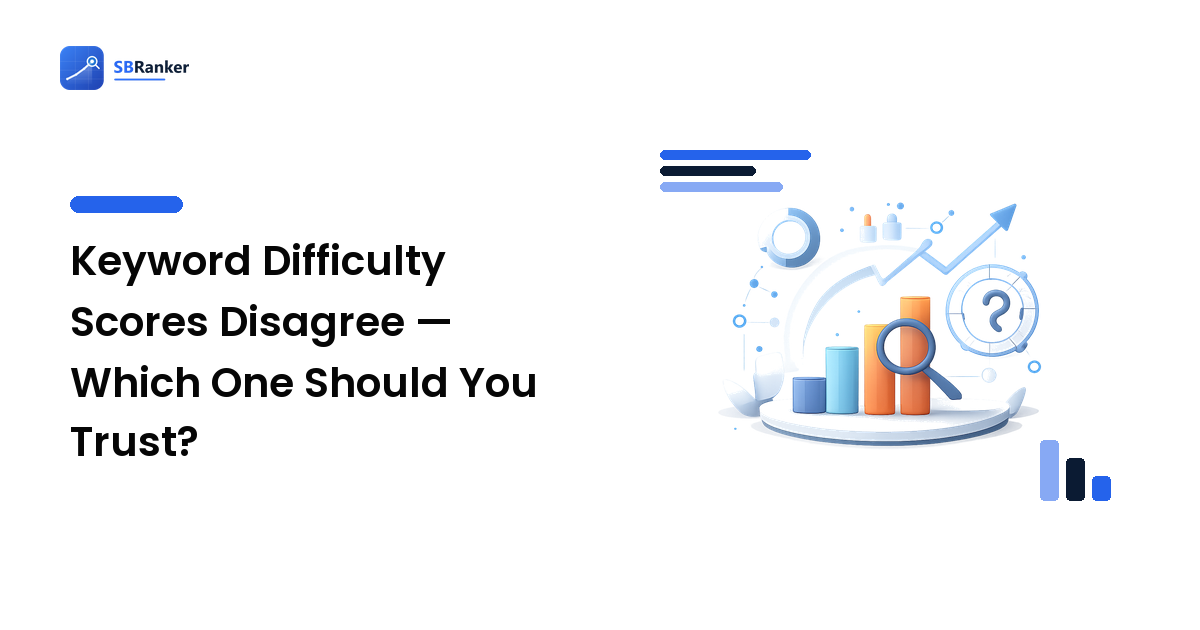
When two keyword tools score the same term wildly differently, neither one is broken and neither one is right. Keyword difficulty is a vendor-invented estimate, not a measurement — each company builds it from its own link index, its own formula, and its own scale. The honest answer to "which should I trust?" is: trust the one you can calibrate against your own ranking history, and use it only to sort candidates in relative order.
That reframing matters more than picking a winner. A difficulty score is not a fact about a keyword. It is one company's compressed opinion about the pages currently ranking, expressed on a scale it invented, with no input from the search engine and no knowledge of your site. Once you see how the number is assembled, the disagreements stop being confusing and start being informative.
What is a keyword difficulty score actually measuring?
Almost every commercial difficulty score works from the same raw material: the pages currently ranking on page one for the query. The tool fetches that results page, looks up its own authority and backlink metrics for each ranking URL, aggregates them, and maps the result onto a 0–100 scale.
So the score is answering a narrow question: how strong, by our metrics, are the pages that currently occupy the top results? That is a reasonable proxy for competition, and it is genuinely useful. But notice what it is not answering — it is not telling you how hard the query is for you, and it is not derived from anything search engines publish about ranking.
Vendors are usually upfront that these are proprietary estimates. Search engines have never endorsed any difficulty metric, and there is no industry standard defining what a 40 means. A 40 in one tool and a 40 in another are two different companies' arithmetic that happen to land on the same two digits.
Why do keyword difficulty scores disagree between tools?
Five mechanisms explain nearly every disagreement you will see.
Different link indexes
Difficulty is built on backlink data, and no vendor sees the whole web. Each runs its own crawler with its own budget, refresh cadence, and rules about which links count — nofollowed links, redirects, spam filtering, and how long a dead link stays in the index all differ. Two tools looking at the same ranking page will simply know about different sets of links pointing at it.
Different formulas and weightings
One vendor may weight referring domains heavily; another may lean on a domain-level authority estimate, page-level strength, or the number of results on the page that look like forums and video rather than optimized commercial pages. Some blend in search volume or click-through expectations. These are design choices, and reasonable people disagree.
Different normalization curves
Every tool squeezes an unbounded underlying value into 0–100, and the shape of that squeeze is a design decision. If one vendor's curve is compressed at the top, most keywords cluster in the middle of the range and only true head terms clear 80; another spreads scores evenly. Identical underlying competition, different printed number.
Different SERP snapshots
The results page is not one fixed thing. It varies by country, city, language, and device, and it changes over time. If two tools sampled the query from different locations, or one cached its snapshot weeks ago, they analysed different sets of competing pages. For queries where local results or news dominate, this alone can swing a score dramatically.
Different query grouping
Some tools fold plurals, close variants, and misspellings together; others keep them separate. When the underlying keyword isn't quite the same keyword, the difficulty attached to it won't be either.
Notice that four of these five have nothing to do with the keyword being harder or easier. They are artefacts of how each vendor built its product.
What keyword difficulty cannot see
The deeper limitation isn't disagreement between vendors — it's that all of them are blind to the same things. A difficulty score has no access to:
- Your site. It doesn't know your domain's standing, your topical track record, or whether you already rank for twenty adjacent queries. The same keyword is genuinely easier for a site with established coverage of that topic.
- Search intent fit. A score built on link metrics can't tell you that every ranking page is a product listing and your planned article will never fit the slot. That mismatch is often the real reason a page fails, and it doesn't register as difficulty at all.
- Content quality, freshness, and brand. Weakly linked pages sometimes rank because they answer the query better or more recently — and some results are held by brands people search for by name. Link aggregates miss both.
- How contested the page really is. Results held by ageing, thin pages on strong domains score as "hard" while being genuinely beatable; recently updated, tightly targeted competitors score lower and are much harder.
That last pair is the practical crux. Difficulty measures the strength of the incumbents, not the quality of the opening.
How to judge keyword difficulty score accuracy for yourself
You can't validate a vendor's scale in the abstract, but you can calibrate it against your own outcomes. That is a far more useful exercise than comparing tools to each other.
- List keywords you have already targeted with a real page. Ten to thirty is plenty. Include wins, partial wins, and failures — the failures carry most of the information.
- Record the difficulty score each one carried when you started, from one tool only.
- Record where each page actually landed, and roughly how long it took.
- Find your personal threshold. You are looking for the band where your outcomes flip — perhaps pages below a certain score reliably reached page one, above it they stalled. That threshold is your site's calibration for that tool's scale, and it is worth far more than any published guidance about what counts as "easy".
- Re-check it as your site grows. Authority and topical coverage move the threshold. Recalibrate after a few months of new results.
Once you have a threshold, the score becomes a genuine filter: not "is this keyword easy?" but "is this keyword inside the band where pages like mine have historically won?"
A practical rule set for using difficulty scores
Ordered by how much decision-making weight each deserves, from most to least, on the basis that data closer to your own site is more trustworthy than modelled data about the web at large:
- Your own ranking history. What you have already won and lost, mapped against scores — measured outcomes from your actual site.
- A manual look at the live results page. Open the query. Read what ranks. Ask whether a page like yours belongs there and whether the intent matches. Ten seconds of this outranks any score, because you see intent, format, and freshness that no aggregate captures.
- Search Console impression and position data. If you already surface for a query at position 30, the engine has confirmed relevance — a fact no difficulty model has.
- One tool's difficulty score, used for relative sorting. Useful for ordering a large list quickly. Never as a pass/fail gate on its own.
- Cross-tool comparison. Least useful for absolutes, but there is one signal worth taking: if tools disagree wildly, that usually means the results page is unstable, mixed-intent, or heavily localized. Treat a large spread as a flag to inspect the query manually, not as a tie to break.
The single biggest workflow improvement is also the dullest: pick one tool and stay in it. Consistency is what makes scores comparable across your own list. Switching tools mid-list is like measuring half your list in centimetres and half in inches, then sorting the numbers.
For the wider process this fits into — seeding, expanding, filtering by intent, and mapping every surviving term to a page — see the keyword research tools and process guide.
Where the answer actually comes from
Difficulty scores estimate whether a query is winnable. Only your tracked positions tell you whether you won it — and the 11–20 band is the clearest evidence of all, because a page sitting there proves the keyword was within reach whatever any score said. Those pages usually respond to a title rewrite, an internal link, or a content upgrade rather than a link-building campaign. Real positions are the only difficulty metric derived from your own site.
Frequently asked questions
Is keyword difficulty an official Google metric?
No. Search engines do not publish a difficulty score and have not endorsed any third-party version. Every difficulty number you see is a vendor's proprietary estimate, built mostly from backlink and authority data about the pages currently ranking. That is why no two tools agree and why there is no correct scale to appeal to.
Which keyword difficulty tool is the most accurate?
There is no way to answer this in general, because there is no ground truth to measure against. Accuracy only becomes meaningful relative to your own site: the best tool is the one whose scores have historically lined up with what you managed to rank for. Calibrate one tool against your past results and use it consistently rather than shopping for a "correct" one.
Why does one tool say a keyword is easy and another says it's hard?
Different link indexes, different formulas, different 0–100 normalization curves, different SERP snapshots by location and date, and different grouping of close variants. Any one of those can move a score substantially, and they compound. A wide spread between tools is best read as a hint that the results page is unstable or mixed-intent.
Should I ignore keyword difficulty scores entirely?
No — just demote them. They are efficient for sorting a long list into a rough order before you spend time on manual review. The mistake is treating a threshold published by a vendor as a decision rule for your site. Use the score to shortlist, then decide by looking at the live results and your own history.
What should I use instead of keyword difficulty?
The live results page, because it shows intent and format directly; your Search Console data, because it proves whether the engine already considers you relevant; and your tracked positions, because they measure the actual outcome. Difficulty is a fourth input, not the first.
Next step
Open the ten terms you care about most and look at the live results for each. Ask whether a page like yours plausibly belongs in that set. Where the answer is yes, the difficulty score is a detail; where it is no, no score was going to save you.
Then measure what happens. Track the positions of the keywords you targeted, watch which pages sit in the 11–20 band, and let your own results calibrate every score you read afterwards — that is what sbranker.com is built for.