Most sites grow their content one post at a time. Someone has an idea, writes it, publishes it, and moves on. A year later there are eighty posts and no plan — a pile, not a structure. The pile rarely ranks well, because search engines are trying to figure out what your site is actually about, and a scatter of unrelated articles gives them no clear answer.
A topic cluster is the fix. Instead of chasing one keyword per post in isolation, you organize related pages around a central subject: one broad pillar page that covers the topic at a high level, surrounded by a set of focused articles that each go deep on one slice of it, all linked together. The whole set ranks better than its parts because it tells a coherent story about your expertise — and because the internal links let authority and relevance flow between the pages.
The takeaway up front: you rank for a topic, not just a keyword, by covering it thoroughly and connecting the coverage. A single great article competes alone. A well-built cluster competes as a team, and the team usually wins.
What a topic cluster actually is
A cluster has three parts, and the relationship between them is the whole point.
- The pillar page. A broad, substantial page that introduces the entire topic and defines its scope — the kind of page that answers "what is X and what does it involve." It targets a wide, high-volume query and links out to every cluster page beneath it.
- Cluster pages. Focused articles that each answer one specific question or sub-topic in depth — the long-tail queries a searcher asks once they are past the basics. Each cluster page targets its own narrow intent and links back up to the pillar.
- The internal links. The connective tissue. The pillar links down to each cluster page; each cluster page links up to the pillar and, where relevant, sideways to its siblings.
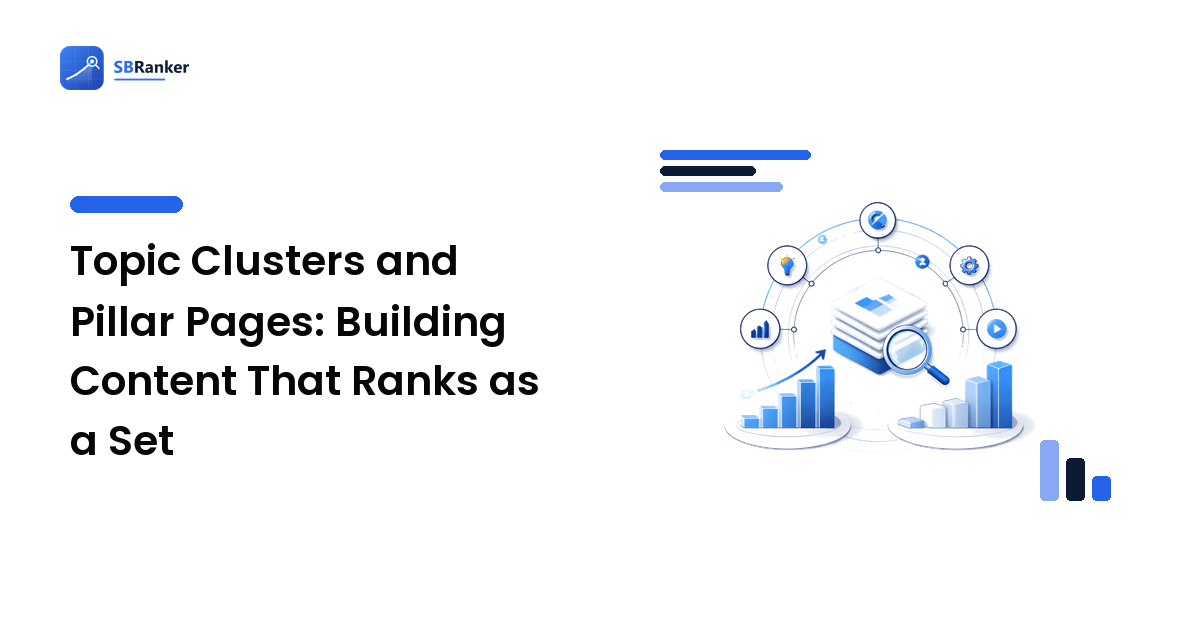
The classic shape is a hub and spokes. The pillar is the hub; the cluster pages are the spokes; the links are what make it a wheel instead of a heap. When a search engine crawls this structure, the pattern is legible: here is a site that has organized real depth around one subject, with a clear entry point and clear supporting detail.
Contrast that with the pile. Eighty posts with no deliberate linking force the crawler to guess at relationships, and they often end up competing with each other for the same queries — the self-inflicted problem covered in keyword cannibalization. Clustering is, in part, cannibalization prevention by design: because you assign each page a distinct slice of the topic up front, your pages stop fighting over the same search.
Why clusters rank better than isolated posts
Three mechanisms are doing the work, and it helps to keep them separate.
Topical coverage. Search engines reward sources that comprehensively address a subject, because a site that answers the follow-up questions as well as the headline one is more likely to satisfy the searcher. A cluster is a deliberate way to be that comprehensive source rather than hoping a single article covers enough.
Internal link equity. Links pass signals. When your pillar page earns backlinks from other sites — as broad, linkable pages tend to — the internal links from that pillar distribute some of that authority to the cluster pages, helping pages that might struggle to earn links on their own. The cluster lets a few strong pages lift the weaker ones.
Clear relevance signals. Descriptive internal links between related pages tell the search engine what each page is about and how the pages relate. A cluster page linked from a pillar with the anchor "how to track keyword rankings" is getting a plain, honest relevance signal for that phrase. Multiply that across a well-linked set and the engine has a strong, consistent map of your site's expertise.
None of this is a trick. You are not manipulating anything — you are making genuine depth easy to find and easy to understand. That is exactly what on-page work is supposed to do, and clusters are on-page structure applied at the level of the whole site rather than one page.
How to build a cluster, step by step
You do not need to publish the whole thing at once. Build the map first, then fill it in over time.
1. Choose the topic and confirm you can own it
Pick a subject broad enough to support ten-plus articles but narrow enough that you can plausibly become a real authority on it. "SEO" is too broad for most sites; "rank tracking for small agencies" is a topic you can actually cover completely. Be honest about scope — a cluster half-built looks thinner than a single strong post.
2. Map the pillar and the spokes before writing
List the sub-questions a searcher works through as they learn the topic. Each distinct question with its own search intent becomes a cluster page; the umbrella becomes the pillar. Do this in a spreadsheet: one row per planned page, with its target query, its intent, and its unique angle. The angle column is your cannibalization insurance — if two rows have the same angle, merge them now, on paper, before they become two competing URLs.
3. Write the pillar as a genuine hub
The pillar should stand on its own as a useful overview and function as a directory. Cover the whole topic at a readable depth, and where a sub-topic deserves more than a few paragraphs, summarize it and link out to the cluster page that handles it in full. A good pillar is the page you would send a smart newcomer to first.
4. Wire the internal links deliberately
This is the step most sites skip, and it is where clusters live or die. Every cluster page links back to the pillar with descriptive anchor text. The pillar links down to every cluster page. Related siblings link to each other where a reader would genuinely want the jump. Use anchors that describe the destination in plain language, not "click here" and not a keyword crammed unnaturally — the same discipline covered in the on-page SEO guide.
5. Publish, then maintain the map
Add cluster pages over time and update the pillar's outbound links each time you publish one. Revisit the map quarterly: retire pages that never found an audience, and split any page that has quietly grown to cover two intents.
Common mistakes that break a cluster
- Thin cluster pages. A cluster of shallow posts is still a pile, just an organized one. Each spoke has to earn its place with real depth on its slice.
- Orphaned pages. A cluster page nobody links to gets none of the structure's benefit. If it is not linked from the pillar and at least one sibling, it is not in the cluster.
- Overlapping angles. Two cluster pages aimed at the same query reintroduce cannibalization inside your own structure. Assign one intent per page and hold the line.
- A pillar that is just a link list. The pillar must be substantial on its own. A page that is only a table of contents earns no links and passes little authority.
- Building for crawlers, not readers. If a link would not help a real reader, it does not belong in the cluster. Every connection should make sense to a person first.
FAQ
How many pages does a topic cluster need?
There is no fixed number. A workable cluster is usually one pillar plus somewhere between five and fifteen cluster pages — enough to cover the topic's real sub-questions without padding. Depth of coverage matters more than a page count; stop when you have honestly answered the topic, not when you hit a quota.
What is the difference between a pillar page and a cluster page?
The pillar page is broad: it introduces the whole topic, targets a wide query, and links out to the detail pages. A cluster page is narrow: it answers one specific sub-question in depth and links back up to the pillar. The pillar is the map; the cluster pages are the destinations.
Do topic clusters cause keyword cannibalization?
Done right, they prevent it. Because you assign each cluster page a distinct query and intent when you map the cluster, your pages target different searches instead of competing. Cannibalization creeps in only when two pages drift onto the same intent — which is why the mapping step matters so much.
How long before a cluster affects rankings?
Longer than a single post, because the benefit compounds as pages are published, linked, and recrawled. Expect it to build over months rather than weeks. The pillar often moves first as it accumulates internal and external links; the cluster pages tend to strengthen as the structure fills in around them.
Next step
You do not need to write the whole cluster today — you need the map. Pick your single most important topic, sketch the pillar, and list the five to ten questions it should link out to. That map is a content plan you can execute one page at a time, and every page you add makes the ones already published a little stronger. To watch whether the cluster is actually moving your positions as it grows, track the target keywords for the pillar and each spoke at sbranker.com.